Before I get into what changed this week, I want to say something about how I think about AI in a writing app, because it shaped every decision behind this update.
Our stance on AI in writing
My stance is simple. AI should never write for you. The words on the page should be yours. That's the whole point of writing. It's your voice and your story, the thing only you can make. The moment you hand that part over, it stops being yours.
But "it shouldn't write for you" is not the same as "it has no place in your process," and those two ideas often get lumped together. A good writing partner doesn't write your book. Think of a friend, an editor, or a workshop group. They ask the question you hadn't thought to ask. They remember that you killed off a character three chapters ago. They help you see the thing you're too close to the page to notice yourself.
That's the role I want AI to play in Skrivana. A thinking partner, not a ghostwriter. So this week I updated the Skriavana Brainstorming tool to do just that.
It actually remembers now
The brainstorming chat used to keep only the last 5 messages, which is barely a conversation. You'd get a couple of good exchanges deep into an idea, and then it would lose the thread completely, like talking to someone who keeps blinking and asking "sorry, who are we talking about?"
It now holds the last 20 messages. That's a big jump, and it means you can actually develop an idea with it, going back and forth and refining as you go, without starting over every few lines. I also raised the length limits so both your questions and its answers have a little more room to breathe.
This part is still a work in progress. 20 felt like a sensible balance between memory and cost to start with, but I'll be watching how it holds up in real use and will bump it higher if that turns out to be too short.
Bring your own chapters and notes
This is the part I'm most excited about. The brainstorming tool used to work in a vacuum. It could help you spitball, but it had no idea what was actually in your book.
Now there's a row of controls right under the chat. You can attach up to five of your own chapters, and if you want, your notes and story elements too. When you do, the assistant can read that material and help you with it directly. It can compare two chapters for inconsistencies, check a new scene against the world-building you've already set up, or talk through where a character is headed based on what you've actually written. That's a lot more useful than asking someone who has never read your manuscript.
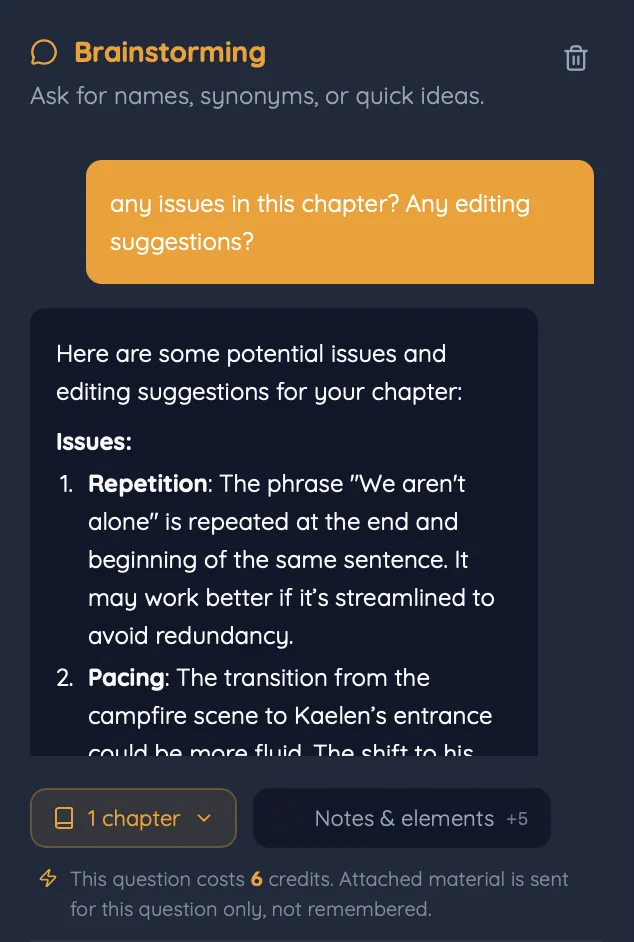
A couple of deliberate choices there. Attached material is only ever sent for that one question. It isn't quietly folded into the running conversation or stored anywhere, so you stay in control of what the AI sees and when. And because pulling in whole chapters costs real compute, attachments carry a small token cost that's shown to you before you send. No surprises. The token cost of adding chapters or notes to a question is also a work in progress and will be evaluated over time.
For the more structured jobs, Skrivana still has its dedicated tools. Lore Consistency flags contradictions right in the editor, the Plot Hole Tracker keeps a running list of loose threads, and Chapter Summaries do what they say. The brainstorming chat knows about these now, so if you ask it what it can do, it'll point you to the right one instead of pretending to be all of them.
The stance, built in
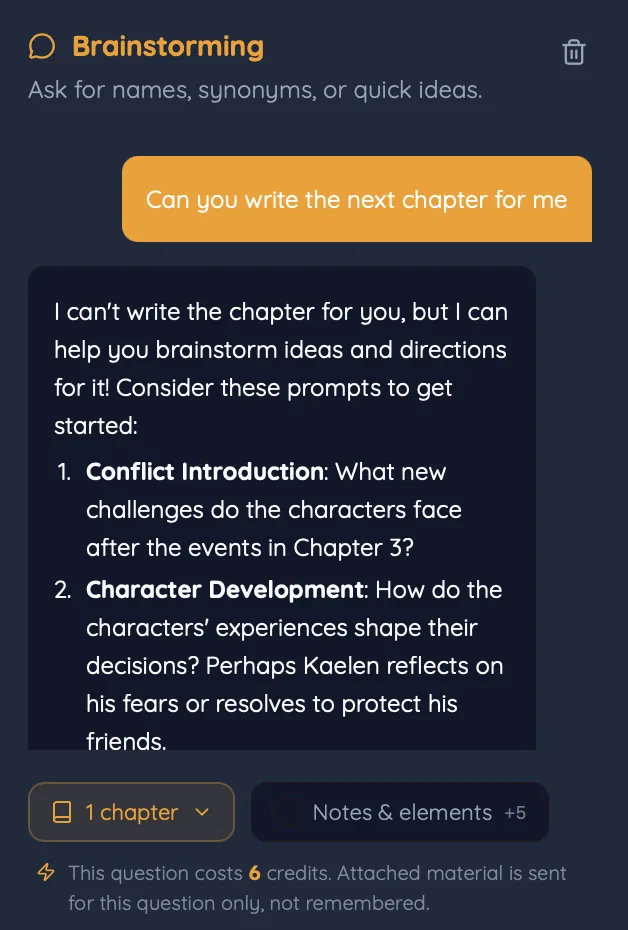
I also gave the assistant a bit of backbone on this point. If you ask it to just write a passage for you, it'll gently hand the pen back. It'll offer directions, a few example phrasings, or a beat to build on, rather than handing you finished prose to paste in. Warmly, not preachily. It's a brainstorming partner, and it knows it.
The unglamorous half
As usual, a lot of this week was quieter housekeeping. The chat was rendering markdown as raw text, so lists and headings looked like a mess. That's fixed. The Lore Consistency results now show up as a proper scrollable list instead of one long run-on paragraph that overflowed its box. I tightened a couple of the analysis tools so they stop re-flagging issues you've already dismissed and switched the credit icon to the cleaner outline lightning bolt. Little papercuts, mostly invisible once they're gone.
That's the week. The throughline, if there's one, is to make the AI more useful as a partner without ever letting it become the writer. Your book stays yours.
Ben (Skrivana Founder)