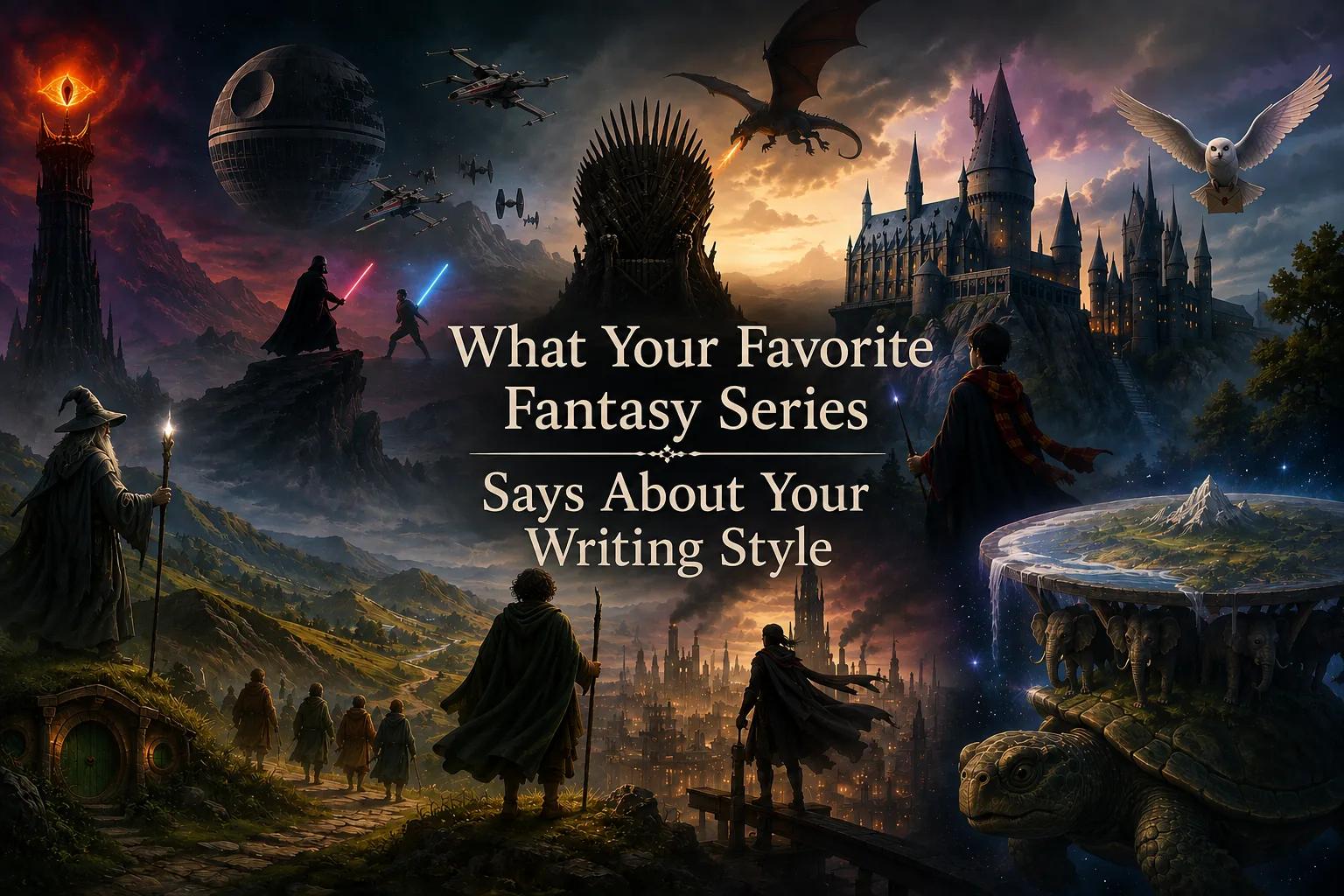
Ask a fantasy writer to name their favorite series. They say it's impossible to pick just one. Then they name one anyway, and it's the same one they named the last four times you asked.
The series that got its hooks into you says something about the kind of writer you are. Not perfectly, but close enough to be a little uncomfortable. Find yourself below, then send this to the friend you already know is the Mistborn one.
The Lord of the Rings
You are a worldbuilder first and a novelist somewhere further down the list. You have a timeline that starts four thousand years before chapter one. You know what your characters eat, what they call their grandparents, and roughly how taxes work in a country nobody visits in the story. You write a short story for a character that is briefly mentioned.
Do readers need all of that? No. Does it matter? Also no, because they can feel it anyway. A world with real history holding it up reads differently than one built out of set dressing, even when the reader never sees a single beam. The risk is spending three years on the beams and never building the house. Eventually somebody has to leave the Shire.
A Song of Ice and Fire
You are not here to protect anyone. Your characters make choices and then live inside the results, and if the result is horrific, they probably should have thought about that sooner. You write politics well because you understand that most conflict is just people wanting incompatible things while being extremely polite about it in public.
Your instinct for consequence is your best asset. Stakes only feel real when a story has proven it will actually follow through, and yours has. The thing to watch is scope. You just added a brand new character, you're up to nine this week, and the ending gets further away every time you sit down. Ask me how I know.
Harry Potter
You lead with heart. Your characters are warm, your friendships feel lived in, and the reason people keep turning pages is that they like being around the people you made up. There's probably a scene where everyone is eating together and nothing plot-relevant happens at all, and it's secretly one of the best scenes in the book.
Readers will forgive almost anything for characters they love. Your magic system may not survive a determined Reddit thread. Nobody cares. The world is fun to be a part of.
The Witcher
You write in grey. Your hero is tired, your villain has a point, and the actual monster in the chapter is usually the least monstrous thing in it. Atmosphere is your superpower. You can make a muddy village at dusk feel like a threat before anyone has said a word.
What makes this work is restraint. You trust the reader to sit with a moral question instead of answering it for them. Just remember that grey only reads as grey when something in the story is worth caring about. Even the bleakest fantasy needs one thing the reader wants protected.
Mistborn
You love a twist, and you earn it. Your foreshadowing is deliberate down to the sentence. There's something in chapter two that won't pay off until the last forty pages, and when it does, readers are going to flip back to check, and it's going to be sitting right there.
You've also re-outlined your ending three times to get every piece to sit flush, which is why your outline document is longer than some people's first drafts. That precision is the whole trick. Twists don't land because they're surprising. They land because the reader realizes they had everything they needed the entire time.
Discworld
You use fantasy to say something true about the actual world, and you're smart enough to make it funny so nobody feels like they wandered into a lecture. Your jokes are load-bearing. Someone reads a page, laughs, and then goes quiet for a second, and that second was the point.
This is the hardest style on the list to pull off, honestly. Humor is fast and precise and unforgiving, and comic writing gets dismissed as lightweight by people who have never tried it. Your writing is sharper than it looks. Keep letting it look easy.
Honorable Mentions
Dungeons and Dragons
Yes, it counts.
You build worlds to be inhabited, not admired from a distance. Your best material shows up ten minutes after somebody does something you didn't plan for. You need the reaction, the raised eyebrow, the "wait, what's behind that door," because that's what pulls the good stuff out of you.
Drafting a novel alone can be rough for this type, since the feedback loop that fuels you isn't there by default. Find a writing group, a beta reader, or one patient friend who will let you explain your magic system over dinner. You're not being needy. That's just how your process works.
Star Wars
Star Wars has wizards, a chosen one, a magic sword, an evil empire, and a farm boy with a destiny. Don't let the spaceships fool you. It's fantasy!
Anyway. If this is your answer, you write iconic before you write intricate. Your characters can be summed up in one line and readers still remember them a decade later. Your mythology is simple on purpose: big, clean ideas that hit hard and stay put. You'd rather have one unforgettable image than four pages of correct history. Most people can't name three facts about the politics of the Old Republic. Everybody can hum the music.
Most of Us Are a Mix
Nobody is only one of these. You might build like Tolkien, joke like Pratchett, and plot like Sanderson, and the mix is the part that makes your writing yours. The series that stick around tend to do the same thing. Deep world, warm characters, real consequences, and a joke that lands right before something terrible happens.
No matter what fantasy series inspires you, all fantasy writing needs a good tool for world building and story telling. That is why I built Skrivana. Skrivana gives you the tools you need to create interesting worlds and stories. It's a writing app for people who take their worlds seriously.