You're deep in a chapter, writing a scene you've been excited about for weeks, and something feels off. You flip back through your manuscript looking for a detail you established thirty thousand words ago. Maybe it was the name of a city. Maybe it was which parent died when she was young, or whether the kingdom's currency is silver or gold, or what color you said his eyes were in the second chapter.
You find the answer eventually, but it cost you a couple minutes and the writing groove you were in is officially dead. And now you've got to spend five minutes getting back into that groove!
Over the course of a writing session, you realize you've lost a lot of precious time to searching for lore details and settling back in once you've found it.
What you're experiencing is lore debt.
What Lore Debt Actually Is
Every detail you invent in a story is a small obligation. When you name a character's sister, describe the architecture of a city, or establish a rule about how magic works in your world, you're writing a check. Your story will cash it later, whether you're ready or not.
Early in a manuscript this feels manageable. You've got everything in your head. The cast is small, the world is simple, and the details are fresh. But stories grow. Casts expand. Worlds develop history. Rules get more complicated. And at some point the debt you've been accumulating starts to show up in ways that hurt: contradictions between chapters, plot holes you didn't catch until you were three acts in, a character who apparently teleported between scenes.
This isn't a failure of imagination. It's a failure of infrastructure. You invented a world complex enough to lose track of, which means you did something right. The problem is that most writers don't build a system for managing what they've created until they're already drowning in it.
How Writers Usually Handle It
When I look at some of the greatest worldbuilders in history, I constantly wonder how they kept their sanity, let alone their lore, in check. I'm particularly obsessed with how Tolkien pulled it off, especially in an era before computers. We read his masterpieces today and don't always realize that he spent vastly more time managing his world's background than he did actually writing the narrative. Lore was such a large focus, pieces of lore would occasionally slip out of one project and wander into another. Take Tom Bombadil, who actually debuted in an obscure poem Tolkien wrote years earlier before showing up in The Lord of the Rings.
Tolkien also regularly broke the classic narrative rule of Chekhov's Gun—the idea that every detail you mention must be vital to the plot. His books are absolutely packed with deep history and random lore drops that are never revisited again. Rules are meant to be broken anyway, so who really cares? But it just goes to show the staggering amount of data Tolkien was constantly juggling in his head and on paper.
Most of us try to handle this weight with a fragmented toolkit. A character sheet here, a timeline there, and a master notes file that started out organized but slowly devolved into a dumping ground for everything we're afraid we'll forget. Some writers use spreadsheets. Some use Notion or a physical notebook. Some rely on their writing app's built-in research folder.
The fatal flaw in all of these methods? They live entirely outside the manuscript. That might have flown back in the days of typewriters, but it's 2026, dang it! We have better technology at our disposal than ever before, yet we're still forcing ourselves to constantly switch contexts just to remember someone's eye color.
What Actually Needs Tracking
Not everything deserves a dedicated note, but some things genuinely need a home.
Characters are the obvious one, but most writers underestimate how much actually matters. It's not just names and physical descriptions. It's relationships, motivations, and the arc of where someone starts versus where they're headed. The details that feel obvious at the start of a draft are the ones you'll blank on six months later when you're finishing it.
Locations matter more than they seem, especially in fantasy. Geography shapes everything: distances, travel times, what a place looks, feels, and smells like. If you've built a world map, your locations need to correspond to what's on it. More than a few drafts have been undone by a character who apparently crossed a mountain range in an afternoon.
Rules are critical in any story with invented systems. Magic, technology, social structure, it doesn't matter. Every system you create has implications, and your story will test them in ways you didn't anticipate. If you haven't written the rules down explicitly, you'll end up inventing exceptions on the fly, and those exceptions will contradict each other.
And then there's lore, all the history, myths, factions, and background texture that makes a world feel real rather than constructed. This stuff is easy to invent and easy to forget. It also tends to become load-bearing without warning. The throwaway detail you invented in chapter four sometimes becomes the hinge point of your ending.
Paying Down the Debt
The writers who handle this best don't wait until they're deep in a draft to start tracking. They build the habit of documenting as they go, treating their worldbuilding notes as a living record rather than a reference document they'll get to eventually.
The practical version of this looks like: every time you introduce something new and meaningful, you write it down somewhere structured. Not a random notes file. Somewhere you can find it again, somewhere it connects to the other things it relates to, and somewhere that's actually close to the writing itself.
What this changes is the nature of the debt. You're still taking it on, because that's unavoidable in a complex story. But you're logging it as you go instead of letting it pile up invisibly. When the story calls in the check later, you know where to look.
Why Skrivana Is Built the Way It Is
Skrivana came out of a frustration I kept running into. I was working on a story with a cast that grew larger than I'd planned, a world that kept expanding, and a system of notes that was nominally organized but practically useless. Finding anything took too long. Making sure I hadn't contradicted myself took even longer.
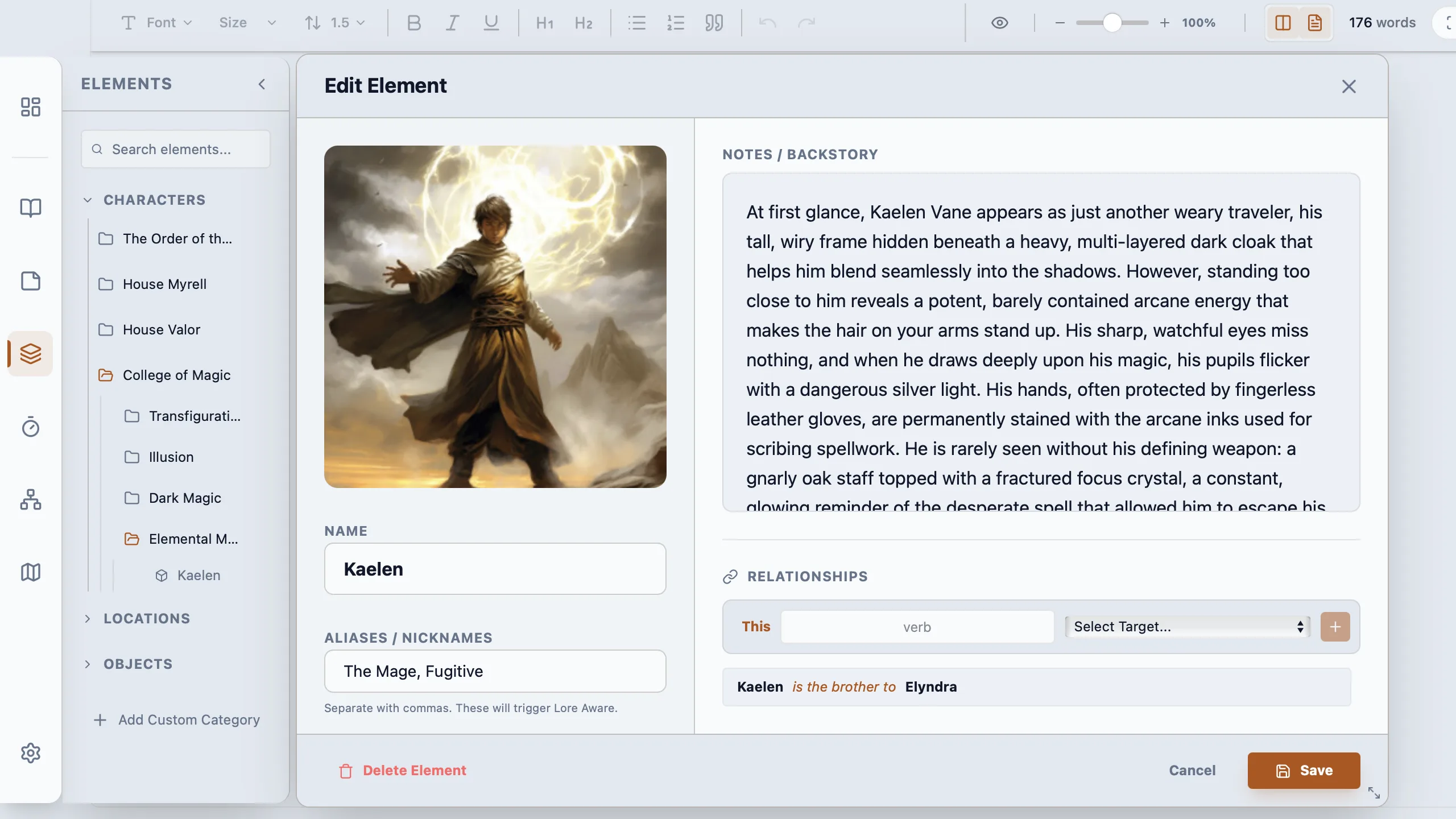
The tools that existed were either built for writing or built for worldbuilding. Nothing brought them together in a way that felt natural to use. That's why I built Skrivana around a simple premise: your world and your manuscript belong in the same room. Instead of buried text files, story elements in Skrivana operate as structured, linkable records embedded directly alongside your workspace. If you need to verify a faction's sigil or a character's backstory in chapter twelve, you can pull up that exact element sheet instantly—no context switching, no lost momentum.
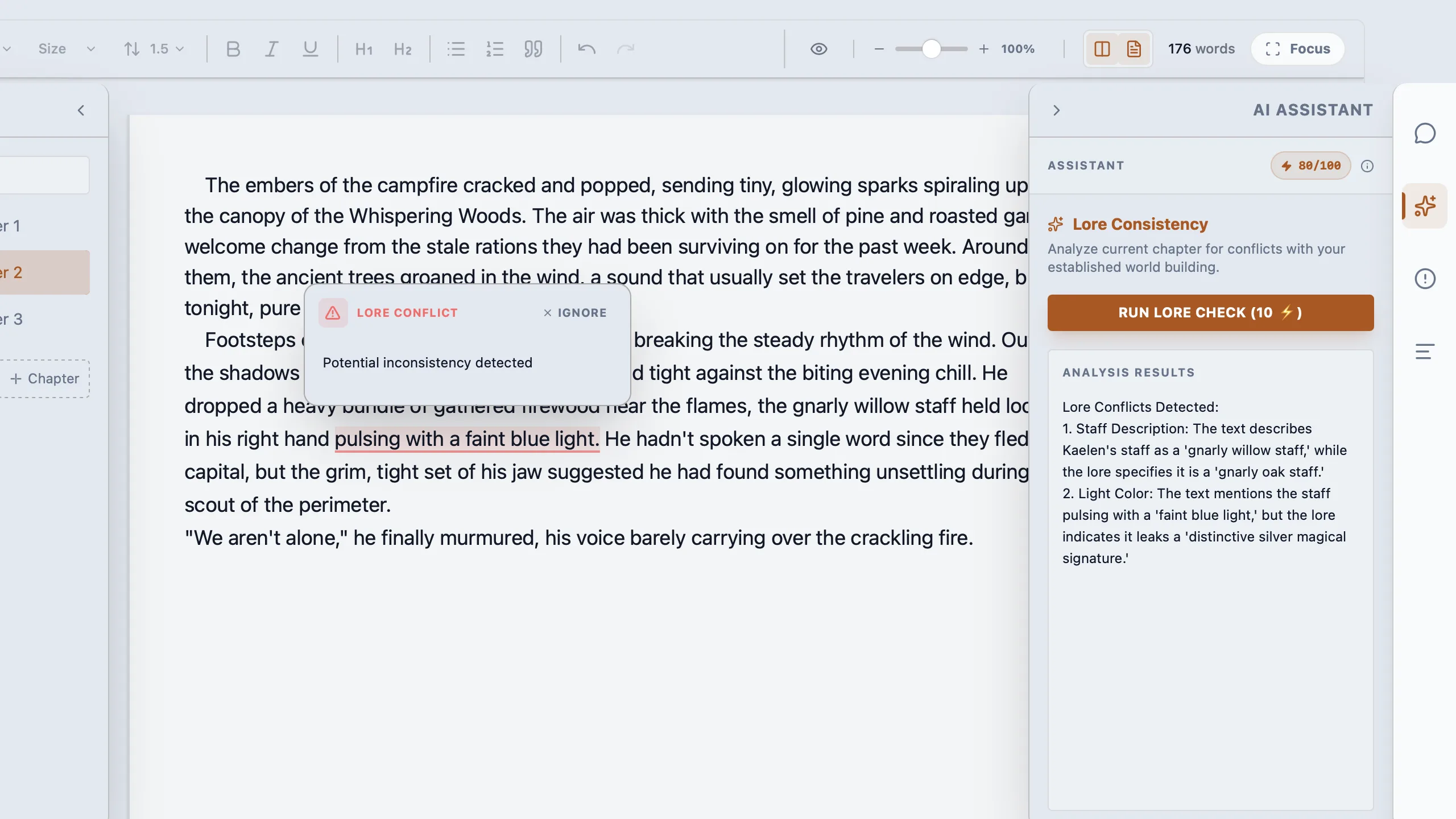
There's also a lore checker built in. It reads what you've written against your story elements and flags inconsistencies you might have missed. It's not there to write your story for you. Think of it less like a writing assistant and more like a careful reader who's absorbed everything you've built and can catch when something doesn't add up.
Lore debt is unavoidable if you're writing something worth writing. The goal isn't to eliminate it. It's to keep it visible, so you can stay in the writing instead of constantly auditing what you've already done.
If that friction is starting to pile up for you, that's exactly what Skrivana is built for.